 WhatsApp Now
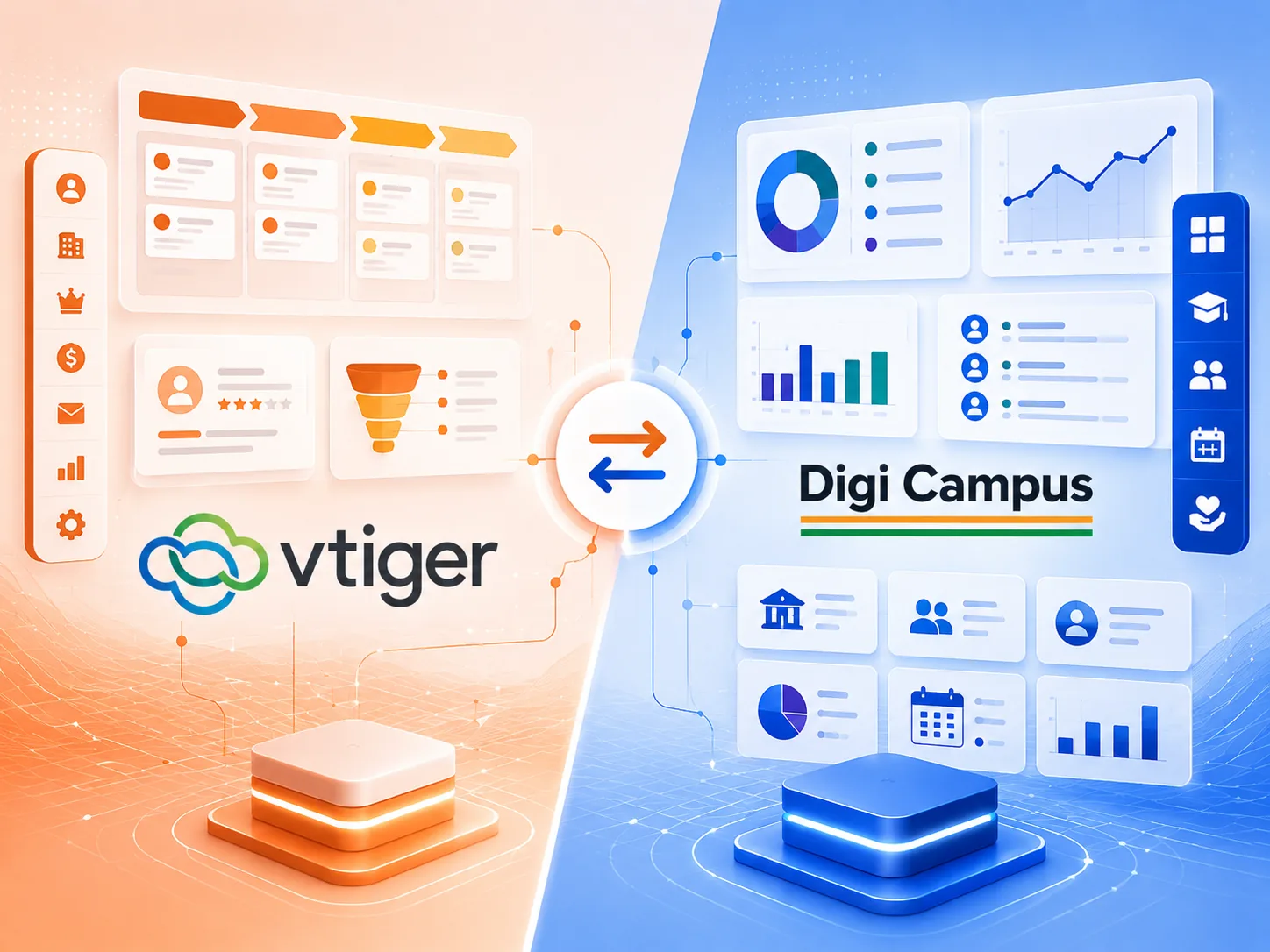
Key takeaways: Vtiger is a capable CRM built around leads, contacts, deals, and sales pipelines. A campus is not a sales pipeline. DigiCampus is purpose-built for ashrams, trusts, and residential schools — with hostel, dining, fees, donations, and HRMS that a CRM was never designed to handle.
In this guide
Why campuses compare Vtiger with DigiCampus
If you run a residential school, ashram, gurukul, or trust, you might already use Vtiger for enquiries or admissions follow-up — and wonder whether it could run the whole institution. It is affordable, open-source-rooted, and good at tracking contacts.
The trouble is that Vtiger is fundamentally a CRM: it thinks in leads, contacts, deals, and pipelines. A campus runs on students, guardians, hostel rooms, mess plates, fee dues, and donation receipts — none of which are CRM concepts. Stretching a CRM to cover them means living in custom modules and workarounds.
This guide compares the two honestly. We will tell you where Vtiger genuinely shines, where it falls short for institutions like yours, and why a purpose-built campus operating system ends up being the faster, calmer choice for most ashrams, trusts, gurukuls, and residential schools.
Two very different starting points
Vtiger starts as a sales CRM. DigiCampus starts as a campus already modelled.
What Vtiger is — and what it is not
Credit where it is due: Vtiger is a solid, affordable CRM. For a sales team tracking leads, deals, quotes, and customer support tickets, it does a genuinely good job and costs far less than enterprise CRMs.
But Vtiger is built around a sales process. Its data model, automations, and reports assume you are moving prospects through a pipeline to a sale. A residential campus has no pipeline — it has resident students, recurring fees, hostel beds, and donors.
The honest framing: Vtiger has no hostel module, no mess module, no fee-concession engine, and no donation-receipt workflow. It has leads, deals, and contacts that you would bend into student records — a poor fit that leaves the hardest campus work (boarding, dining, dues) unsolved.
The campus gap in a business CRM
Here is what actually breaks when you try to run a residential campus on a business CRM like Vtiger:
No native hostel logic
Room allotment, occupancy, vacancy, and student-to-bed mapping don’t exist as concepts. You’d model them with custom objects.
No mess or dining flow
Meal plans, daily mess attendance, and per-plate costing have no out-of-the-box home in a business platform.
Fees aren’t invoices
Term fees, concessions, scholarships, sibling discounts, and dues don’t map cleanly to B2B sales invoices.
Donations need receipts
Donation tracking, 80G-style receipts, and donor history are campaign workflows, not vendor bills.
Guardians, not customers
A student record links to guardians, hostel, dining, fees, and history — a relationship a CRM contact won’t capture.
Trustee reporting
Trustees want collections, occupancy, and donation reports — not P&L dashboards built for shareholders.
A CRM can be customised, but it can only stretch so far. The core campus jobs — hostel allotment, mess attendance, fee concessions, donation receipts — sit entirely outside what a CRM was built to do, so you end up with a half-system plus spreadsheets for the rest.
Already evaluating Vtiger for your campus?
Tell us what you're trying to run — hostel, fees, dining, donations — on WhatsApp. We'll show you the same workflows working out of the box in DigiCampus.
Vtiger vs DigiCampus, side by side
Here is the comparison that matters for an institution — not feature counts, but how each system handles the work a campus actually does every day.
| For a campus | Vtiger | DigiCampus |
|---|---|---|
| Built for institutions | ✕ Sales CRM, stretched to fit | ✓ Purpose-built for ashrams, trusts & campuses |
| Student vs contact | ✕ Contacts & leads, not student records | ✓ One complete student record |
| Hostel & room allotment | ✕ No hostel concept at all | ✓ Native hostel module out of the box |
| Dining / mess management | ✕ Not possible without heavy custom work | ✓ Native dining & mess attendance |
| Fees, concessions & dues | ✕ No fee engine; CRM has no dues model | ✓ Purpose-built fee engine with concessions |
| Donations & receipts | ✕ Approximated from deals/invoices | ✓ Donation module with donor receipts |
| Time to go live | ✕ Weeks of customisation, gaps remain | ✓ Typically 7–10 working days |
| Support that knows campuses | ✕ Generic CRM support | ✓ Team fluent in ashram & school operations |
This is not a knock on Vtiger’s engineering — it is capable software. It’s a statement about fit. The closer a tool starts to your real operation, the less you pay to bridge the gap. For a campus, DigiCampus simply starts much closer.
The real cost of ownership
Vtiger’s per-user CRM pricing is affordable. But for a campus, the subscription buys you the wrong tool — and the real cost is the customisation and the spreadsheets you still need for everything a CRM can’t do:
Where the money actually goes
For a campus, the issue with Vtiger isn’t price — it’s that the core jobs stay unsolved no matter how much you spend.
Even a cheap CRM is expensive if it leaves half your operation in spreadsheets. The hidden cost of Vtiger for a campus is the work it can’t do — hostel, dining, fees, donations — which keeps living on paper and Excel.
Rule of thumb: If a tool can’t natively handle hostel, fees, dining, and donations, its price is irrelevant — a purpose-built campus OS that covers all of them is the real saving.
When Vtiger is genuinely the right call
We will be straight with you: Vtiger is the better choice in some situations. Pick Vtiger if:
- You need a standalone CRM for admissions enquiries and follow-up, and run the campus separately.
- You have a sales-style operation (a coaching business, course sales) where pipelines genuinely apply.
- You want a cheap contact database and nothing more.
- Campus operations are handled elsewhere and Vtiger is just for outreach.
If that's you, Vtiger is a capable option. But if your day revolves around students, hostels, fees, dining, donations, and keeping trustees informed — read on.
Why DigiCampus wins for campuses
For an ashram, a trust, a gurukul, or a residential school, the winning system is the one that already understands your world the moment you log in. That is what DigiCampus is built to be — not a sales CRM stretched to look like a campus system, but a campus operating system from the ground up.
What you get on day one with DigiCampus
The campus workflows a CRM can never natively handle are simply switched on.
The deeper advantage is that the modules are connected by design. A boarding student's record links to their hostel room, their mess attendance, their fee dues, and their guardian's WhatsApp — automatically, because the system was modelled as a campus. In a CRM, there is no native place for any of those links — you end up maintaining custom modules plus spreadsheets.
The bottom line: Vtiger asks “where is this contact in the pipeline?” DigiCampus asks “where is this student in hostel, dining, and fees?” For a campus, only the second question matters.
See DigiCampus run your campus
Share your student count, hostel setup, and fee structure on WhatsApp. We'll show you the exact workflows live in 20 minutes.
Common questions
Can Vtiger run a school or ashram?
Vtiger is a CRM built for sales leads, contacts, and pipelines. It has no native hostel, dining, fee-concession, or donation-receipt features, so it can only handle admissions outreach — not the core operations of a residential campus. DigiCampus is purpose-built for those workflows.
Is DigiCampus a good Vtiger alternative for campuses?
Yes. Where Vtiger gives you a contact database, DigiCampus gives you a complete campus: student records linked to hostel, dining, fees, and donations, with trustee reporting — all out of the box and fully managed.
We already use Vtiger for enquiries — do we replace it?
Many campuses keep a CRM for outreach and run DigiCampus for operations. The point is that hostel, dining, fees, and donations belong in a campus OS, not a CRM — DigiCampus handles them natively so they no longer live in spreadsheets.
The right tool for the job wins
Vtiger is a good CRM for a sales team. DigiCampus is a campus operating system for institutions — hostel, dining, fees, and donations, all built in and managed, live in days. If your institution is a school, ashram, gurukul, or trust, you need a campus OS, not a CRM.