 WhatsApp Now
Key takeaways: Teachmint started as a teaching and classroom platform and added school-ERP features. DigiCampus is a full campus operating system built for residential institutions — hostel, dining, fees, donations, and trustee reporting. For ashrams, gurukuls, trusts, and boarding schools, operations depth beats a teaching-first origin.
In this guide
Why campuses compare Teachmint with DigiCampus
If you run a residential school, ashram, gurukul, or trust, you may have seen Teachmint — it grew popular as a teaching and classroom app and has expanded into school-ERP territory with attendance, fees, and admissions.
The question is depth where it counts. Teachmint is teaching-first: its roots are classrooms, content, and engagement. A residential campus needs operations-first depth — hostel allotment, mess, per-student fee concessions, donations, and trustee reports — which is a different discipline from teaching tools.
This guide compares the two honestly. We will tell you where Teachmint genuinely shines, where it falls short for institutions like yours, and why a purpose-built campus operating system ends up being the faster, calmer choice for most ashrams, trusts, gurukuls, and residential schools.
Two very different starting points
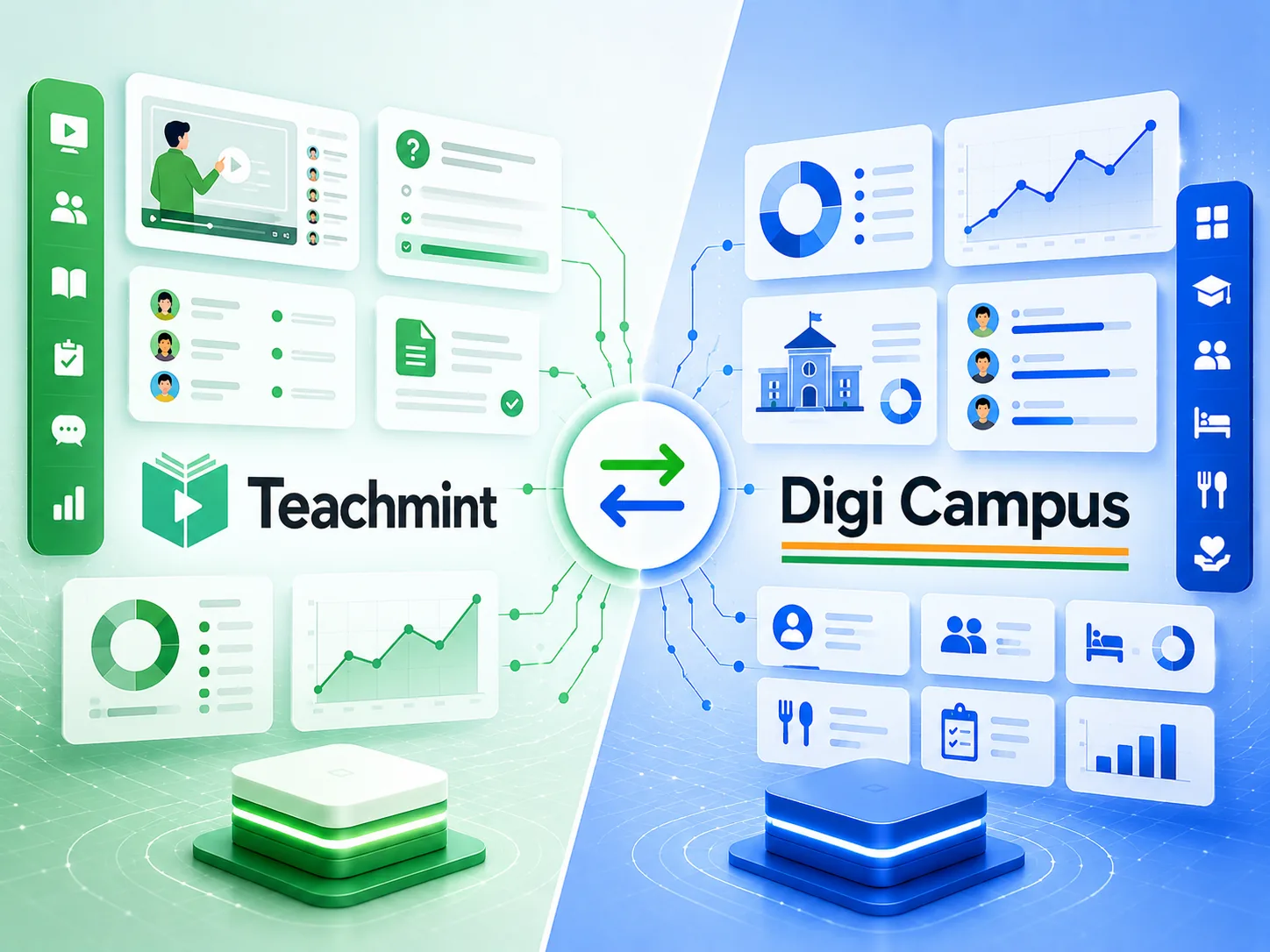
Teachmint starts teaching-first. DigiCampus starts operations-first, for a residential campus.
What Teachmint is — and what it is not
Credit where it is due: Teachmint built a genuinely popular teaching platform, and for classroom delivery, content, and engagement it is polished and easy to adopt.
But a residential campus does not run on teaching tools — it runs on operations. Hostel, mess, fee concessions, donations, and trustee reporting are deep operational workflows, and a platform born from classrooms tends to be lighter exactly where a residential institution is heaviest.
The honest framing: For a residential ashram, gurukul, or trust, the workflows that decide your day — hostel allotment, daily mess, fee concessions, donor receipts, trustee reports — are operations a teaching-first platform addresses lightly, if at all. That is where a campus OS pulls ahead.
Teaching-first vs operations-first
Here is where a teaching-first platform tends to fall short for running a residential campus:
Hostel is an afterthought
Most school ERPs bolt on a thin hostel tab — no real allotment, occupancy, or mess linkage that residential campuses need.
No dining / mess depth
Daily mess attendance, meal plans, and per-plate costing for boarders are rarely modelled properly.
No donation engine
Trusts and ashrams run on donations and 80G receipts — something day-school software simply doesn’t address.
Not built for ashrams
Gurukuls, ashrams, and trusts have flows (sevadars, residents, donors) a CBSE-style school ERP never considered.
Siloed add-ons
Hostel, fees, and HR are often separate paid modules that don’t share one clean student record.
Generic reporting
Reports target day-school principals, not trustees who care about occupancy, dining, and donations.
For online teaching or a classroom-focused school, Teachmint is a fine fit. For a residential ashram, gurukul, or trust, the operations it doesn’t go deep on are exactly the ones that fill your office — and a campus OS exists to run them.
Already evaluating Teachmint for your campus?
Tell us what you're trying to run — hostel, fees, dining, donations — on WhatsApp. We'll show you the same workflows working out of the box in DigiCampus.
Teachmint vs DigiCampus, side by side
Here is the comparison that matters for an institution — not feature counts, but how each system handles the work a campus actually does every day.
| For a campus | Teachmint | DigiCampus |
|---|---|---|
| Origin | ✕ Teaching / classroom app | ✓ Campus operations platform |
| Built for | ✕ Classroom delivery & engagement | ✓ Ashrams, gurukuls, trusts & boarders |
| Hostel & room allotment | ✕ Not a focus | ✓ Native hostel module out of the box |
| Dining / mess for boarders | ✕ Not a focus | ✓ Native dining & mess attendance |
| Fees, concessions & dues | ✕ Basic | ✓ Purpose-built fee engine with concessions |
| Donations & 80G receipts | ✕ Not built for it | ✓ Donation module with donor receipts |
| Trustee reporting | ✕ Engagement-oriented | ✓ Collections, occupancy & donation reports |
| Single connected record | ✕ Classroom-centric | ✓ One record across school, hostel, fees, dining |
This is not a knock on Teachmint’s teaching tools — they are good. It’s about operations depth. A residential campus is run by its operations, and that is precisely where DigiCampus is built to be strong.
The real cost of ownership
Teachmint can be inexpensive to start. For a residential campus, the cost that matters is the operations work it doesn’t cover — hostel, mess, donations — which keeps living on spreadsheets and staff time:
Where the money actually goes
For a residential campus, the cost gap is the operations depth a teaching-first platform leaves on spreadsheets.
When a residential campus counts the spreadsheets it still keeps for hostel, mess, and donations beside a teaching-first app, the low entry price is offset by the operations work the platform can’t run.
Rule of thumb: For a residential institution, pick the system with real operations depth — hostel, dining, fees, donations — not the teaching app that handles them lightly.
When Teachmint is genuinely the right call
We will be straight with you: Teachmint is the better choice in some situations. Pick Teachmint if:
- Your priority is classroom teaching, content, and engagement above operations.
- You run online or coaching classes where teaching tools are the core need.
- You have little boarding and no donation or trust workflows.
- You want a light, fast teaching app and full operations are out of scope.
If that's you, Teachmint is a capable option. But if your day revolves around students, hostels, fees, dining, donations, and keeping trustees informed — read on.
Why DigiCampus wins for campuses
For an ashram, a trust, a gurukul, or a residential school, the winning system is the one that already understands your world the moment you log in. That is what DigiCampus is built to be — not a teaching app extended toward campus operations, but a campus operating system from the ground up.
What you get on day one with DigiCampus
The deep campus operations a teaching-first platform skims — hostel, dining, fees, donations — are switched on here.
The deeper advantage is that the modules are connected by design. A boarding student's record links to their hostel room, their mess attendance, their fee dues, and their guardian's WhatsApp — automatically, because the system was modelled as a campus. In a teaching-first platform, those operational links are light or absent, so they fall back to spreadsheets.
The bottom line: Teachmint answers “how is the class going?” DigiCampus answers “how is the campus running — hostel, mess, fees, donations?” For a residential institution, operations decide it.
See DigiCampus run your campus
Share your student count, hostel setup, and fee structure on WhatsApp. We'll show you the exact workflows live in 20 minutes.
Common questions
Is DigiCampus a good Teachmint alternative for campuses?
Yes. Teachmint is teaching-first; DigiCampus is a full campus operating system with deep hostel, dining, fees, and donation workflows connected to academics — built for residential ashrams, gurukuls, and trusts and live in days.
Does Teachmint handle hostel, mess, and donations?
Those operations are not Teachmint’s focus — its strength is classroom teaching and engagement. DigiCampus runs hostel allotment, daily mess attendance, fee concessions, and donor receipts natively as core campus operations.
We need full campus operations, not just teaching — which fits?
DigiCampus. It is built operations-first for residential campuses, so hostel, dining, fees, and donations are core modules sharing one student record — not add-ons to a teaching app.
The right tool for the job wins
Teachmint is strong at teaching. DigiCampus is a full campus operating system — hostel, dining, fees, and donations connected to academics, live in days and managed. For an ashram, gurukul, trust, or boarding school, you need operations depth, not just a classroom.