 WhatsApp Now
Key takeaways: Odoo is a horizontal business ERP that needs configuration, partners, and custom modules to fit a campus. DigiCampus is purpose-built for ashrams, trusts, and residential schools — with native hostel, dining, fees, donations, and HRMS that work together on day one. Campuses go live with DigiCampus in days, not months, and without a developer on retainer.
In this guide
Why campuses compare Odoo with DigiCampus
If you run a residential school, ashram, gurukul, or charitable trust, sooner or later someone suggests Odoo. It is open-source, it has modules for almost everything, and it has a reputation as an affordable all-in-one ERP. On paper, it looks like it could run your whole institution.
The trouble starts when you map Odoo onto how a campus actually works. A business ERP thinks in customers, vendors, sales orders, and invoices. A campus thinks in students, guardians, hostel rooms, mess plates, fee concessions, donation receipts, and trustee reports. Those are not the same shapes — and bending one into the other is exactly where the cost, the delay, and the frustration live.
This guide compares the two honestly. We will tell you where Odoo genuinely shines, where it falls short for institutions like yours, and why a purpose-built campus operating system ends up being the faster, cheaper, and calmer choice for most ashrams, trusts, and residential schools.
Two very different starting points
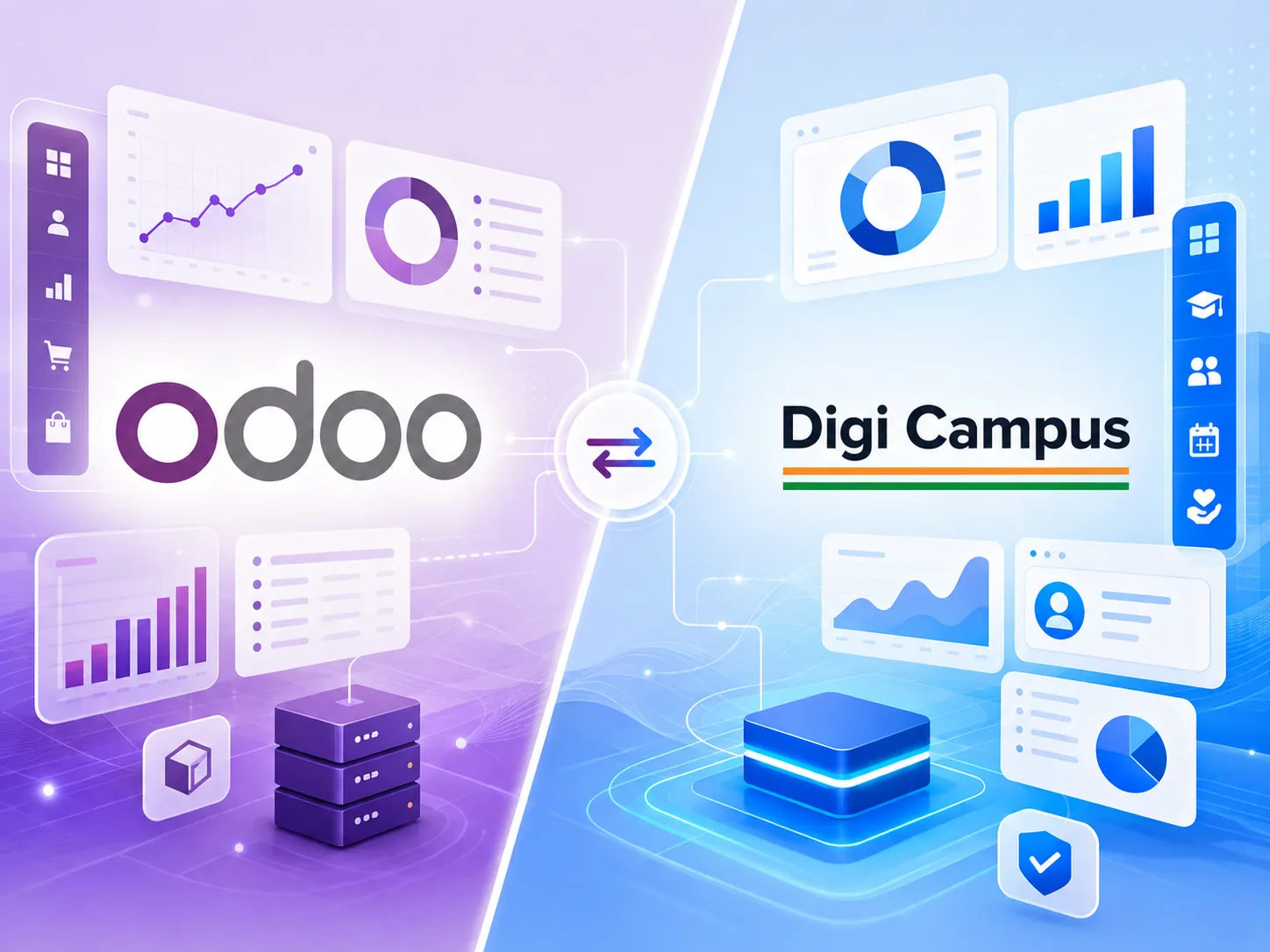
Odoo starts as a business toolkit you assemble. DigiCampus starts as a campus already modelled.
What Odoo is — and what it is not
Credit where it is due: Odoo is an excellent piece of software. It is a mature, flexible, modular ERP used by hundreds of thousands of businesses worldwide. For a manufacturer, a retailer, or a services company, it can run accounting, sales, CRM, inventory, and HR beautifully.
But Odoo is a horizontal platform. It gives you building blocks and expects you — or a paid implementation partner — to assemble them into your specific operation. That flexibility is a strength for a software company with a development budget. For a trust office running on a few committed staff, it becomes a project.
The honest framing: Odoo does not have a hostel module, a mess/dining module, a fee-concession engine, or a donation-receipt workflow built for an ashram. It has generic sales, inventory, and accounting that a partner can customise to approximate those things. "Approximate" and "customise" are where the time and money go.
The campus gap in a business ERP
Here is what actually breaks when you try to run a residential campus on a business ERP like Odoo:
No native hostel logic
Room allotment, occupancy, vacancy, and student-to-bed mapping don't exist as concepts. You'd model them as inventory or custom objects.
No mess or dining flow
Meal plans, daily mess attendance, and per-plate costing have no out-of-the-box home in a business ERP.
Fees aren't invoices
Term fees, concessions, scholarships, sibling discounts, and dues don't map cleanly to B2B sales invoices.
Donations need receipts
Donation tracking, 80G-style receipts, and donor history are campaign workflows, not vendor bills.
Guardians, not customers
A student record links to guardians, hostel, dining, fees, and history — a relationship a CRM contact won't capture.
Trustee reporting
Management and trustees want collections, occupancy, and donation reports — not P&L dashboards built for shareholders.
None of this is impossible in Odoo. With a skilled partner and enough budget, almost anything can be built. But every one of these gaps becomes a line item in a customisation quote, a delay in your go-live, and a dependency on someone who understands both Odoo and your campus. Most institutions discover this only after the project has started.
Already evaluating Odoo for your campus?
Tell us what you're trying to run — hostel, fees, dining, donations — on WhatsApp. We'll show you the same workflows working out of the box in DigiCampus, no custom build.
Odoo vs DigiCampus, side by side
Here is the comparison that matters for an institution — not feature counts, but how each system handles the work a campus actually does every day.
| For a campus | Odoo | DigiCampus |
|---|---|---|
| Built for institutions | ✕ Horizontal business ERP, adapted to fit | ✓ Purpose-built for ashrams, trusts & campuses |
| Hostel & room allotment | ✕ No native module; needs customisation | ✓ Native hostel module out of the box |
| Dining / mess management | ✕ Not available; modelled manually | ✓ Native dining & mess attendance |
| Fees, concessions & dues | ✕ Approximated via sales invoices | ✓ Purpose-built fee engine with concessions |
| Donations & receipts | ✕ Adapted from vendor/accounting flows | ✓ Donation module with donor receipts |
| Time to go live | ✕ Weeks to months with a partner | ✓ Typically 7–10 working days |
| Custom development needed | ✕ Usually, for campus workflows | ✓ None — modules ship campus-ready |
| Ongoing developer dependence | ✕ Partner or in-house dev often required | ✓ Run by your own office staff |
| Support that knows campuses | ✕ Generic ERP / partner support | ✓ Team fluent in ashram & school operations |
This is not a knock on Odoo's engineering — it is genuinely strong software. It's a statement about fit. The closer a tool starts to your real operation, the less you pay to bridge the gap. For a campus, DigiCampus simply starts much closer.
The real cost of ownership
Odoo's headline appeal is cost — there's a free Community edition, and licensing can look inexpensive. But for a campus, the licence is rarely the real expense. The total cost of ownership comes from everything you need to make it work:
Where the money actually goes
For most institutions, the gap between Odoo's sticker price and its real cost is implementation — not licensing.
When institutions add up partner fees, custom-module development, hosting, upgrades, and the staff time spent managing a developer relationship, the "cheaper" option frequently turns out to cost more over two or three years — and it ties the institution to outside expertise it can't easily replace.
Rule of thumb: If the quote to make a business ERP behave like a campus system runs into lakhs and several months, a purpose-built campus OS that's live in a fortnight is almost always the better financial decision.
When Odoo is genuinely the right call
We will be straight with you: Odoo is the better choice in some situations. Pick Odoo if:
- You run a commercial business alongside the institution — manufacturing, large-scale retail, or trading — where Odoo's core strengths apply directly.
- You have an in-house development team or a long-term partner budget and want a fully bespoke system you control end to end.
- Your requirements are highly unusual and you're willing to invest in building exactly what you envision.
- Campus operations are a small part of a much larger, business-heavy organisation.
If that's you, Odoo is a serious, capable platform and worth the investment. But if your day revolves around students, hostels, fees, dining, donations, and keeping trustees informed — read on.
Why DigiCampus wins for campuses
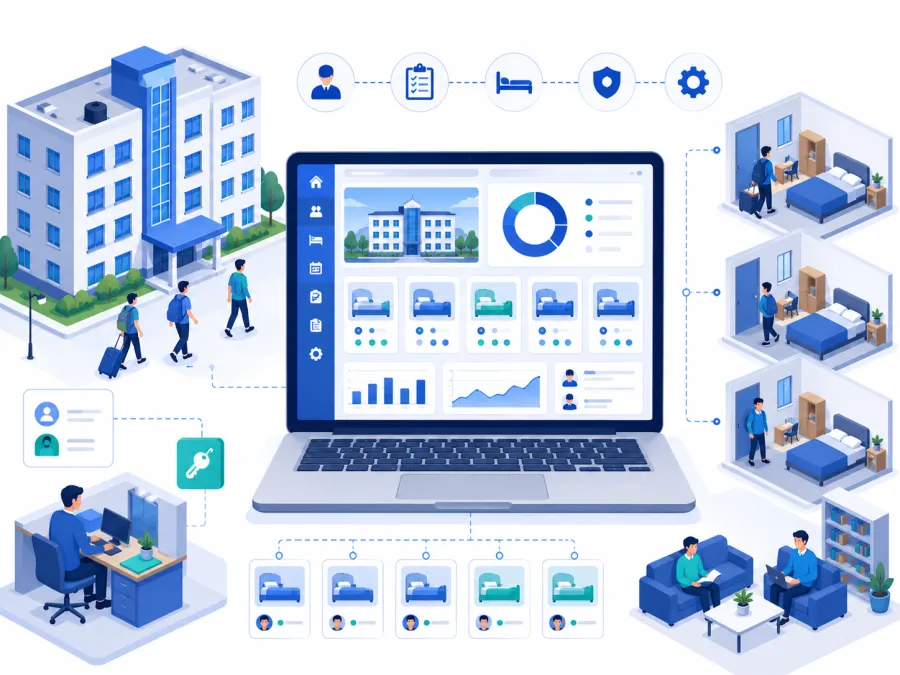
For an ashram, a trust, a gurukul, or a residential school, the winning system is the one that already understands your world the moment you log in. That is what DigiCampus is built to be — not a business ERP wearing a campus costume, but a campus operating system from the ground up.
What you get on day one with DigiCampus
The campus workflows that take months to build in Odoo are simply switched on.
The deeper advantage is that the modules are connected by design. A boarding student's record links to their hostel room, their mess attendance, their fee dues, and their guardian's WhatsApp — automatically, because the system was modelled as a campus. In a business ERP, every one of those links is a custom integration someone has to build and maintain.
The bottom line: Odoo asks "what can we build for you?" DigiCampus answers "here's your campus, already running." For institutions that want to spend their time on students and operations — not on a software project — that difference decides it.
See DigiCampus run your campus — not a generic ERP
Share your student count, hostel setup, and fee structure on WhatsApp. We'll show you the exact workflows live in 20 minutes — the ones Odoo would take months to approximate.
Common questions
Is DigiCampus a good Odoo alternative for schools and ashrams?
Yes. Odoo is a horizontal business ERP built for companies. DigiCampus is purpose-built for residential schools, ashrams, gurukuls, and trusts, with native hostel, dining, fees, donations, and HRMS modules that work together out of the box — no custom development needed.
Why do campuses move from Odoo to DigiCampus?
Odoo requires configuration, partners, and custom modules to fit campus workflows like hostel allotment, mess attendance, fee concessions, and donation receipts. DigiCampus ships these as standard modules, so institutions go live in days instead of months and without ongoing developer dependence.
Does DigiCampus cost less than Odoo for a campus?
For campuses, total cost of ownership is usually lower with DigiCampus because there are no implementation-partner fees, no paid custom modules, and no developer retainer. DigiCampus uses transparent module-based pricing built for institutions, not per-app enterprise licensing.
Can DigiCampus do everything Odoo does?
DigiCampus focuses on campus operations rather than general business functions like manufacturing or large-scale trading. For institutions whose core work is running a campus, that focus is the advantage — every module is built for how schools, ashrams, and trusts actually operate.
The right tool for the job wins
Odoo is excellent at being a business ERP. DigiCampus is excellent at being a campus. If your institution is a school, ashram, gurukul, or trust, the purpose-built choice gets you live faster, costs less to run, and frees your staff to focus on people instead of a software project. See it on your own campus in a 20-minute walkthrough.